kimberlysteele: (Default)
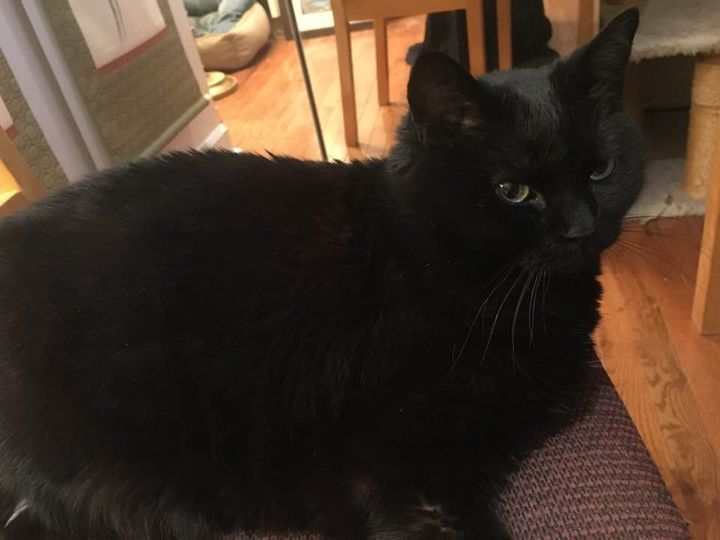
I know someone who is fat. When she runs, her belly swings back and forth, flapping both against itself and her legs. She is rarely motivated to exercise, save running into the next room to eat her favorite food. She is addicted to a crunchy snack that promises on the container that it has only two calories per serving. The only problem is that like potato chips, she never can stop at one.

This fat individual is my beloved feline, Kiki. The snacks in question are Temptations cat treats. To be fair, my cat is elderly and there's no way I'm going to put her on a diet at this phase in her life. I won't deny her treats, though I can't allow her to eat them 24/7 as is her inclination either.


Gluttony is the most common deadly sin of all, thanks to our era of cheap petroleum wealth and the plentiful food and other forms of material excess it creates. My ability to care for a cat (plus a colony of ferals outside) in general is the result of excess: there are many other societies I could have been born into, both in this time and the ones before it, where adopting a pet would not have been feasible. I'm always shocked at how many people don't think about how much food we have compared to those who went before us. Or how many toys children have. Or how big houses have gotten.

Gluttony is Ingratitude

Gluttony is the most disposable form of hoarding. Gluttony means not sharing. Gluttony means taking far more than you need or sometimes taking more than you want. Excess does not occur in a vaccuum; that is to say it always comes from somewhere and at someone's expense. My cat is chubby while children in poorer homes than mine in this very town are going hungry. The slaughterhouse remnants and heaven knows what else that goes into her treats comes from the most hellish places on earth. The big guy stuffing his face at a fancy restaurant means that someone else (or more likely many someone elses) is starving. Shrimp farming not only destroys the most fragile and valuable ecosystems, it employs human slaves. Chocolate is produced by slaves, many of them children. Avocados are the product of violent cartels. Food production is often unfair and violent and the only way to ameliorate this condition is to grow everything you eat, which is obviously far easier said than done. Nevertheless, the throwing up your hands and not even trying because you can't be perfect approach is the number one reason our world is so mucked up, and that's why I don't advocate that form of nihilism.

Let's say there is a sale on chocolate bars. Instead of buying just one or two bars to savor, I scoop the entire shelf of them into my basket because hell, why not. I can afford it! Then I go home and binge. Or maybe I put them all in the freezer for later.  Or sell them for a profit.  The moral here is that I could have let my community share in the treats but instead I chose to stop everyone else from enjoying the chocolate so I could abuse it like an illegal drug.

This sort of tragedy of the commons pops up all over the place, in fact, this scenario played out rather oddly in the form of toilet paper shortages in 2020. Alternately, let's say I have the privilege of free time. I decide to use my free time to binge on Netflix or videogames in place of any work I could do that has a chance of improving myself the world around me. My mindless bingeing spirals into an addiction, and before you know it, shooting zombies in an onscreen fantasy land and/or watching the dramatization of a math teacher who sunk to selling meth becomes how I occupy most of my non-work day.

Everyone should be able to let off a little steam now and then.  Enjoying a little extra food, Netflix, games, or toilet paper is not problematic.  It's when the glut becomes a way of life that we lose appreciation for what we are given.  Inundating oneself in any form of pleasure for weeks, months, and years at a time is the quickest way to become desensitized to that pleasure.  Recovering drug addicts say that they are unable to feel joy in the things that used to bring them joy.  Their threshold to feel good at all has been raised to a stratospheric height.  To glut is to run away from the at first inconvenient/annoying and later on horrendous tests of deprivation.  

The Opposite of Gluttony: Orthorexia 

Ah, the "nothing is ever good or pure enough for me crowd".  I once made an hour and a half trip to Chicago with two friends of mine in order to go to a vegan restaurant on the North side.  My friends, also from the suburbs, traveled with me by train.  When we got to the restaurant, my now ex-friend went full prima donna, refusing to eat at the place because they did not have canned or bottled soda.  We sat at the restaurant for a half hour while he threw the thirty-something's version of a tantrum.  A long argument ensued -- he had designs on backpacking through Europe -- about why his Land of Precious attitude wouldn't fly in most parts of the world outside the molly-coddled US.  He won.  We went to another restaurant one or two el train stops away where they had soda in cans and bottles.

Never Say Diet  

Orthorexia is also ingratitude.  Dieting creates a push to which there is a corresponding pull.  Don't create the push and you won't get a pull.  Don't pick at the scab because you are bored -- instead of healing, it will bleed and potentially get infected.  Dieting is molesting to the scab to the point where it becomes a gaping wound far worse than the original mosquito bite.  

Dieting is always a short term project, no matter what the guru diet writer claims on his book jacket.  The body has a perverse way of fighting back.  To diet successfully to ultra-thinness is almost guaranteed to either permanently damage you, make you into a terrible person, or both.  Depriving oneself of food is an addiction.  I know this because I have been vegetarian for 30 years of my life and vegan for 11 of them.  There is a self-righteous glory in denying oneself of certain types of food.  Though I personally do not have an eating disorder, I know plenty of vegans who are disordered eaters. 

Dieting is a form of killing the messenger.  The appetite for food is the messenger -- dieting murders him and buries his body in a shallow, fetid grave.  An unhealthy relationship with food should never be addressed with a diet.  Instead, it should be tackled first and foremost with discursive meditation.  Dieting is the ultimate thoughtstopper that is designed to prevent you from analyzing your own psyche in a meaningful way.  It is a bandaid.  Why sit still in a chair and think about your life's troubles when you could be planning an improved grocery shopping list that will deliver The New You in a few short weeks?  

Changing your eating habits needs to be an extremely mild, almost unnoticeable process if it is going to stick.  Personally, if I wanted to lose weight, I would not revamp my diet or my portion sizes overnight.  Instead, I would subtract one food item, let's say corn chips, and eat salted nuts instead.  It is really important to replace the missing food item when you are trying to make a change -- this is why successful vegans have to expand their diets beyond the unholy trinity of french fries, ersatz meats, and box wine.  I would create no friction for my body to resist.

Long ago, I was forced to take a class in high school called Aerobics Slimnastics.  This class, which was the alternative to skilled sports that I sucked at, required us to document our daily calorie intake for eight weeks.  For a friend of mine I'll call Gina, documenting what she ate triggered anorexia.  I remember her being proud of limiting herself to less than 800 calories a day.  At 4'11", my weight hovered around 110 pounds through most of high school.  Gina was six inches taller than me.  She got down to 95 pounds at one point.  I'm pretty sure she was subsisting upon 500 calories a day.   I remember the sadness in her eyes when she said, "Do you remember when we were kids and we didn't have to try to be thin all the time?  Those were the days."

Dieting is Ungrateful

Like my soda-preferring ex-friend, there's not a great deal of gratitude in dieting.  Dieting is a rich person's game -- the poor cannot afford to play.  I remember when I first fell into the lower middle class and I pondered the delectable irony of my vegan peers who extended Herculean efforts to stop themselves from hoovering up vast amounts of delicious, Instagram-worthy food I simply could not afford.  There's nothing like choosing between paying an electric bill and a grocery trip to keep the waistline trim, especially when you're an ethical vegan and fast, non-homemade food is largely off the menu!  

I believe that in the future nobody will go on diets... they won't need to because they won't have enough food to get fat in the first place.  

Moderation

Moderation will never sell any diet books because it is boring, it is cheap, and it works.   A leitmotif of my Seven Deadly Sins meditations has been this theme of not diving off the plank at either end of the pool.  

I weigh more than I did high school -- I would guess that I weigh about 125 pounds or so but I have not weighed myself in nearly a decade.  I don't get weighed at the doctor because I don't have health insurance, so I don't visit the doctor for regular checkups.  Despite my middle-aged weight gain, I remain serenely unconcerned.  Getting fat isn't the end of the world.  Staying skinny does not make me a better person.  Another bonus is that when your hips and arms inflate, your head stops looking so huge on top of your body.  But even if I lost all of my padding and became a hideously shriveled, black-haired lollipop, I wouldn't sweat it.  I'm old and it's not my time to be the object of desire -- that torch I gladly pass on to women younger and prettier than me.  

What seems to work the best for me and always has is eating when I am hungry.  I don't torture myself about a late night sandwich.  If I'm hungry, I just eat.  I have neither binged nor purged in this incarnation and I have no plans to start.  I wish I could go back in time and somehow get Gina to eat a normal, home-cooked meal despite the admonitions of the crazy Aerobics Slimnastics teacher, who by the way was morbidly obese.  I don't talk to Gina anymore, but I suspect she still battles with food as most of the women of my generation were conditioned.  

And so I wrap up my Seven Deadly Sins meditations -- I hope you enjoyed reading them half as much as I have enjoyed writing them!  The Aristotlean approach of transforming each Sin into a ternary was one I employed (and still employ) to understand the Ogham.  As always, I appreciate any thoughts you care to contribute in the comments and though I doubt I need to mention it, I thank everyone in advance for avoiding the use of profanity.

kimberlysteele: (Default)

Modern people in the so-called First World are absolutely beset with Sloth.  We are physically, emotionally, and mentally lazy.  Take me, for instance.  Here I am, drinking my cup of tea.  I didn't flap my arms and fly to India to grow it and pick it.  I certainly didn't gather the water from the nearby river (frozen at the moment) and I didn't build the filter that made the water potable.  I didn't build the stove that boiled the water.  I didn't mold or fire the pottery that brewed it.  I did almost nothing to make my beautiful cup of English Breakfast.  When I deposit what's left of my tea back into the ecosystem, I won't be doing it into a cold, self-constructed outhouse.  No, I'll be doing that business in the toilet in my petroleum-heated home, full of rooms I did not build.

The Lazy Man's Load

The above example is meant to illustrate just how much most of us take for granted.  It's a rare soul who can deal with how much privilege we have nowadays by the simple virtue being born into this era.  For those who call themselves Social Justice Warriors, any attention brought to the mundane luxuries of middle class life tends to trigger violent and extraordinary dissonance.  "Not me!" They cry, grasping desperately at their victim card, eager to play another round of Who Is The Most Oppressed?  Ridden by anxiety, the Social Justice crowd would rather spend their lives mired in depression and prolonged mental breakdown than go deep and potentially skewer their precious egos in the process.  For as they say in Alcoholics Anonymous, the first step to recovery is admitting you have a problem.  

Back when I was a kid and I didn't want to practice the piano, I would distract myself with every form of demoralizing nonsense.  I would run into many brick walls: not being able to sightread with proficiency, difficulty concentrating, boredom with repeating a passage I needed to learn, and that would stop me from practicing because it was pointless.  I was never going to be smart enough, coordinated enough, or graceful enough, and since I couldn't win I got distracted with doing other things I had a chance of being better at.  Because I remember my own state well, I make a special point of combatting this form of demoralization with my music students.  I tell them they just have to practice and that they must learn to ignore those feelings of not being good enough or talented enough. 

I say, "You must stop weaponizing your own insecurities and aiming them back in your own direction." 

Once those insecurities have been set aside, no matter how compelling they seem, you have to sit down and get to work.  Yes, there is a twelve year old who can play the piano better than you can.  To top that, there is a six year old who plays better than the twelve year old, and that has not stopped the twelve year old.

In short, don't work so hard at creatively sabotaging yourself or making excuses why you cannot practice.  Practice, even if it isn't the best quality practice or you can't manage the sonata the six year old mastered in a week.   

Enablers

The saddest thing I have ever seen was an adult child getting out of the car with his mom after a trip to the grocery store.  The grocery bag spilled.  The twenty-something son, who suffered a mental disorder (or several of them) but was physically healthy and robust, stepped over the upturned bag and went into the house.  His mother was left to pick up the groceries and schlep the rest of the cargo into the house on her own.  

There's a woman I know, now elderly, who has come home for forty years to a husband who has never had a full time job and lives on the couch, drinking beer.  She runs a business that puts a roof over his head and pays for their family to exist.  She says of her slovenly mate, "I love him, so what can you do?"

I know a man whose wife inherited a small fortune: approximately a hundred thousand dollars in money and possessions.  She has not worked since her marriage and subsequent inheritance in the early 2000s.  Though he is the breadwinner and works sixty plus hour weeks, she does not pick up the slack by cooking, cleaning, gardening, or running a business out of the house.  She has already spent her inheritance several times over and has a raging shopping addiction.  To this day, she still doesn't lift a finger around their overlarge, McMansion-size house. 

Lazy people don't think of themselves as lazy.  The lazy person will often complain about how rough they have it and often they are tortured by mental illness and depression.  Look closely at the ones who seem content and in stark relief you will witness how they numb themselves with endless hours in front of the television and with compulsive spending.  Examine them and you will find their hoard, their inability to let go of mental and physical junk, and their insecurity.  Underneath their laziness, they are terrified.  

Zombie Like Me

Zombies represent a couple of phenomena in our culture.  The first is the Shadow.  Zombies are classic shadow projection for us humans as a species.  For one, zombies are dumb.  They are ruled by instinct and base urges.  They are incapable of working together on purpose: look at any zombie horde in a film and you will see they have no organizational skills.  Zombies are also cannibals who ruin every place they occupy and destroy every living thing in their path.  Propagandists can Ted Talk all they want about the glorious potentials of the human mind: we all know people are zombies at heart.  There is no Star Trek future because we couldn't get along for enough time to settle another planet even if we could survive the radiation or the relentless cold of outer space.  

That's what makes the I Believe In Science group such a farce.  The proud scientist with a cushy job (the kind that has health insurance and paid vacations) who obediently wears a mask to lower the transmission possibilities of a flu with 99 percent survival rate is not smart.  Instead, she is superstitious.  How many comfortably numb scientists, those without the backbone to stand up to a soft mandate, would act nobly under harsher circumstances?  The Siberian gulags reduced normal people to their worst in a few weeks.   In a few short, brutal strokes, the comfortable scientist is easily transformed into a slavering zombie.

In the Jordan Peele film Us, zombies are portrayed as doppelgangers: dumb, menacing mirror image stalkers who menace their living counterparts shortly before death.  Though the zombies of Us were mostly non-verbal, the one who did feature a voice explained enough to reveal a healthy dash of privileged guilt.  I believe the zombies in the film Us represent the families in the euphemistically termed "developing nations" who make the stuff that keeps the affluent Western salary class up and running.  For all of the bellowing we hear from the fortunate about equality, there are always those telltale Made In China tags that speak of hideous alternate realities where Uyghur slaves are worked quite literally to death.  If they cared as much as they claim to care, how could they let such a thing happen?  Aren't these the same people who claim that if you're not outraged, you're not paying attention?  If we judge them by their actions and not their words, it would follow they must not be paying attention...

Martyrdom: The Opposite of Sloth

There is an old Iranian tale about a sculptor who saw a beautiful woman passing by in a caravan.  He fell in love with her at first sight.  Utilizing all his skill and resources, he bankrupted himself and built a palace for her in the desert with every luxury.  He built the place thinking that she would see it and fall in love with him an live happily ever after.  When they met again, the girl rejected his efforts.  Despondent, he threw himself from the highest tower in his desert palace.  

Martyrs don't always die for good causes and the Iranian sculptor in the myth above is one of those martyrs.  The Bible wisely describes this form of pathology "pearls before swine" and cautions any talented, motivated people who would waste themselves on lost causes.  The three enablers of my previous paragraphs would do well to ask themselves hard questions, such as what caused them to get involved with a Sloth in a co-dependent relationship and how much it would cost them to get out.

Martyrdom doesn't always help the people it is ostensibly for: a classic example is battle-prone parents who stay together "for the children".  

Diligence

Diligence is the recognition and observation of limits. "Diligence" is far too simple a term for the balancing point between Sloth and Martyrdom, so if you can suggest a more subtle word or phrase, I'm all in. 

Gratitude, as per usual, comes to the rescue as the condition of Sloth as well as Martyrdom are marked by a lack of gratitude.  For the Sloth, their ungratefulness creates a petulant expectation that the world owes them a living.  Correcting slothfulness involves lucid assessment of one's own limits: for instance, admitting I am gifted but lazy was the first step to developing better practice habits as a musician.  If you cannot calmly walk through your own negative behavior because you're either too afraid to look at it or in complete denial it exists, you won't be able to correct it.

For the Martyr, there is a single-minded compulsion to overwork for work's sake, and there is an absence of appreciation for the here and now because the future they are working for is always more important than the present.  I once watched a documentary about awful working conditions for Chinese factory workers.  In one factory, these workers -- entirely women -- sewed cheap clothing all day in fourteen hour shifts.  Conditions were horrible.  During her interview, one of the young women spoke about how she put up with the relentless abuse and horrors. She survived by thinking of her brother, to whom her pittance was going to in order for him to continue his studies.  She spoke of him as if she was the lowly disciple and he was the Savior.  It was obscene.  She unquestionably accepted her suffering in an act of Sartrean bad faith, immolating herself on the pyre of Chinese filial piety.  

Diligence is the acknowledgement of privilege as well as the acknowledgement of one's own shortcomings and the resolution to do the thing.  Diligence rejects "should" and it rejects demoralization.  Diligence does not play mind games of avoidance.  Diligence does not greedily presume exact results.  Diligence can act as a retreat from limits in the case of correcting martyrdom or a pushing of limits in the case of correcting sloth.  Both paths wrangle thoughtstoppers and prevent a slide into futile directions, dredging the muck from the subconsciousness and watching it wriggle and squirm in the light of day.  Now, off to practice the piano...


kimberlysteele: (Default)
At face value, lust is about sex and sex alone. I would argue that construing lust as exclusively about sexual desire is a grave mistake. Lust is about appetites, and for this reason, it crosses hairs with Greed and Envy. Lust is trickier than its brothers Greed and Envy though because an excess or dearth of lust isn't as cut and dried as the other two sins. Lust takes a more sustaining role in our existence: without it, we become pale shadows who waste away, or worse, who get picked off by predators who have stronger appetites than we do. Lust is the foodaholic's dilemma: they want to stop overeating, but they must eat the addictive substance every day in order to stay alive.

A Tale of Two Sex Addicts

I know a couple of people who are addicted to sex. One is a woman and one is a man; both are well beyond what is considered their sexual peaks. The woman was raised in a fanatic Christian setting. Her mother was like the non-cartoon, not-quite-as-violent version of the mother of Carrie in Stephen King's novel of the same title. The woman became a nymphomaniac a few years after puberty, catching a venereal disease before having two children, and then having a hysterectomy, yet still going on to compulsively marry over a dozen men, a few of whom she divorced and married again. Her appetite for sex has always been a life-ruining curse. Her Christian upbringing prevented her from doing the logical thing: becoming a highly paid escort. Nowadays, she seems to have gotten her act together and she has stopped her marriage habit.

The other sex addict, the man, was raised in a Catholic in name only, non-churchgoing household. He was a late bloomer who lost his virginity to a woman at eighteen and short time later to a man. He knew himself to be gay from a young age. He felt tormented for his gayness and was depressed for decades over being made fun of for his slightly effeminate bearing in school. Once he felt sufficiently free to do so, he began to compulsively bed different men to the tune of three or four per month. Like in the case of the woman, he ended up with a common venereal disease. For him, the illicit thrill of "getting away with it" has compelled him to cheat while in committed relationships. Unlike her, he still compulsively seeks sex via apps like Tindr -- though I imagine now that he is nowhere near as attractive as he once was, I would not be surprised if he was paying for sex. Sex addictions are the ultimate in diminishing returns.

Satiety

Speaking of diminishing returns, the lust for food is a rough ride. I dated a food addict once, and I was in just about the wrongest of wrong places to be intimately involved with a food addict at that time in my life. Perhaps because I starved to death previously in other lifetimes, I have never been able to sustain a personal addiction to food. I leave chocolate in the cupboard until it gets chalky on the edges. This is not out of willpower; I just don't care enough about it to eat it in the middle of the night. I have never met another woman who does this, including the skinny type of woman who watches her waistline. My food addict boyfriend thought about food all the time. There was never a moment when he wasn't peckish -- I don't think he ever said "I'm too full to eat anything else," not even after a feast.

The problem with excessive lust is that it makes you want to go in a thousand directions at once. All of the lusty people mentioned above are exceptionally creative and self-motivated individuals. Their misfortune is to have lust spill over into areas that earn them venereal diseases and hundreds of pounds of adipose tissue. Lust and creativity have the same driving force, I am convinced, and that is why lust is a key to perpetuating the human species.

I was terrified of getting pregnant from age 12 until age 31, when I was sterilized by my request on the operating table while undergoing a routine uterine surgery. Though I knew better as an adolescent, I always had the paranoid suspicion one could somehow get pregnant from a toilet seat. My predicament while young was to want sex with a boy yet to be profoundly disgusted and disappointed by the burden of fear I would have to carry on my shoulders as a result. When you fear getting pregnant as I did, there is no joy in sex and it is impossible to relax.

I learned early on that lust has dire consequences. As a female child of the Professional Managerial Class, it was instilled in me at an early age that certain paths led to surefire ruin. One of those dark avenues was drugs: I came of age in the fried egg, This Is Your Brain on Drugs era, and my superstitious fear of them was almost as ridiculous as my trepidation about toilet seats. I was also told that having a baby before my late twenties or early thirties was life-ruining doom. I was supposed to have a career, you see, and to do that, I had to go to college. I was supposed to have lust in the proper order, for my degree, my career, and then my lawfully-wedded salary class husband. I was supposed to join the ranks of mostly-barren thirty-something women who jacked themselves up on pricey fertility treatments.  All so I could have kids graduating college just as I collected my first social security payout...  

There Can Be Only One

Lust is a condition of appetites. You want to go down every path because of it, to screw and/or marry every sexual partner, to eat one of each at the buffet and then vomit and do it all again. You want to be Aleister Crowley, gobbling up experiences and shoveling money and your reputation into the roaring fire with abandon. But the path of any single Lust is the Highlander: there can be only one. You can't take every path; this is the predicament of being human. Sleeping with the guy in high school or college (without tons of prophylactics and birth control drugs) means pregnancy and a baby human to whom you must relinquish your freedom. Eating the marijuana brownie means hanging out with the crowd that eventually does heroin, so best to opt out while you still can.

From Bad To Worse: Chastity

The absence of Lust is perverse too -- Elmer Milquetoast, who subsists upon the bland pablum of other's castoffs and what is already put in place. As much as I abused by my overeater boyfriend, I would have treated an Elmer Milquetoast far worse. For the life of me, when I was young, I could not empathize at all with a person of diminished appetites. There are plenty of these people: mamma's boys and girls content to shuffle along, collecting the privileges and prizes of life without fighting for them, doing exactly what is expected of them and nothing more. There are also vast classes of people who give up too early: settling for less in love, in work, in the place where they are situated.  Nature abhors a vacuum.

When people reject their appetites, the result is cowardice. The well of integrity is the same one from which appetites stem. Anorexia is a study in fear of the appetite. The anorexic seeks an excess measure of control because their normal appetite for food scares them. Had I rejected my truth and settled and married my overeater boyfriend, who was an is a very decent guy, I would have done so because I thought I could control what I wanted to want.

The sexually lusty are often drawn to the Catholic priesthood or nunneries because they crave a system of order for their appetites. This is a "from the frying pan into the fire" situation most of the time because it fails to deal with the astral plane conditions that drive desire.  Channeling lust in such a direction is one of the reasons priests have such awful reputations for being pederasts and why nuns have reputations for being cruel and mean.

Balance: Enjoyment

I don't think I could have achieved a balance of my lusts as a young person. I narrowly avoided the life-ruining pregnancies and addictions that I feared, and had I been forced to face them by having a baby or becoming addicted to crack, I don't know whether it would have helped or hurt. It is only on the other side of libido and sterilization that I am able to look at my younger years with a critical eye.

Like many in this culture, I rarely enjoyed myself when I was young, despite having a good home, plenty of money, and oodles of entertainment designed to amuse me.  I was too preoccupied with either guilt or wanting to get to the next thing to enjoy the moment.  That's our culture: when you are doing a thing, always think of the next thing!  Progress!  And if you have any extra, you'd better hoard it and save it because you wouldn't want anyone else getting in on that action.  It's no wonder I was so stunted when it came to normal human stuff like enjoying time with friends or working behind a sales counter.  I had no idea how to enjoy any part of my life.  

Our materialistic culture insists we must always be the pawns in a push-pull game of denial and indulgence.  Financial gurus shame us for buying a latte while commercials goad us into thinking we need to have one in hand in order to be hip.  My thoughts are that if you want a latte, just buy one and be done with it; nobody can reasonably be held accountable for every purchase.  Poverty's root cause is not the occasional four dollar drink and beating oneself over it is pointless.  

Enjoyment is a balance of the way one perceives time.  The lusty perceive time as fleeting and scarce, so that's why they have the urge to jam an entire apple pie down their throat in one sitting or to boink the entire football team because they can.  The chaste shrink in fear from the idea of having a sliver of pie or kissing the star quarterback despite the fact he asked.  The chaste don't suspect time will run out and they wouldn't want to take a risk.  They are masters of delaying gratification, and they end up missing the opportunity for it altogether.  Balance takes into account the moment as ephemeral.  Kissing the quarterback behind the bleachers may not be the wisest idea, and the piece of pie might cause a couple pounds on the thighs, but since some moments only happen once, you go for it, damn the consequences.

kimberlysteele: (Default)
You say you never compromise
With the mystery tramp, but now you realize
He's not selling any alibis
As you stare into the vacuum of his eyes
And say do you want to make a deal?

-Bob Dylan, Like A Rolling Stone


Pride: I'm no stranger to it. I have had the weird experience of being the nerdiest of nerds and the hottie within the span of a few years. I was the ugly duckling that turned into a swan, and like many swans, I became arrogant and resentful of people in general because I perceived myself as being treated badly as a duckling.

The Ugly American Trope

Americans have a pride problem. We display pride where it doesn't belong. Many of us think it is OK to go to the store in pajamas and flip flops. Before the Coronapocalypse, some of us who had the money to travel abroad were known as obnoxious tourists: loud, badly dressed, ignorant, and proud. For a while there, we had an awful lot of chutzpah, spreading our Disney movies and greasy fast food to every corner on the globe along with wars nobody asked for. Nowadays we find ourselves shrinking back from Empire (I hope, anyways) and forced to take a raincheck. We aren't used to having to behave this modestly.

I can tell you from deep personal experience that pride is most often a function of insecurity. Take a proud Christian man I knew who grew up hard and poor on a farm, his life a series of bitter disappointments. He had two things: his God and his pride. He spoke with certainty that he was going to spend an eternity with his Father in Heaven, and because of this, he had a death fetish that included not one but two living funerals for himself. He held these two pre-funerals so everyone could recognize his achievements and celebrate his assured ascent to the pearly gates. Another proud Christian man I knew somehow attained a PhD while not being able to execute a grammatically-correct paragraph. Pride does not have a great deal in common with reality.

The proud are always under threat, whether this is real or perceived. They lack a sense of humor if the fun is being poked at them.  Anger is their constant companion. They confuse one type of achievement with another: Christian Man number one confused being given the short end of the stick in life with being holy, and Christian Man number two confused his ability to cheat the system into providing him with a degree with real intelligence. The proud are impossible to convince of their own vices/faults. If you told either of these guys what was going on in their own heads, they would curse you. If they were young, they might try and throttle you.

Pride and Pulchritude

When I was prouder, I thought myself smarter and better-looking than I actually was.  At age twenty-one, at the acme of my beauty and when I cared a great deal about it, I thought I was a genius 10 when truth be told I was more like an 8 with a somewhat above average brain. Beauty is in the eye of the beholder, and I'm confident for a select few (my husband at least seems to be fooled) I am an 11, off the charts, hubba hubba. For others, I am and always was a meh at best: too short, too odd, not enough, too much.

This is meatworld. The Perfect 10 does not stay that way for long. At the apex of my physical attractiveness in my early twenties, it was all higher, tighter, cuter, and trimmer than it ever would be again. Today's TikTok cutie is tomorrow's ancient swamp hag.  As I have said many times, if you don't let go of pretty by age forty, it will eat you alive. Plastic surgery will not help. Surgery renders the aged into freakish, B-version mockups of their former twenty-something selves, a turn of the head revealing a telltale scar or a dent in a cheek or nose. There's the creepiness of a face that is frozen and unable to move as if the entire thing was Novocained.  The best case scenario -- looking a convincing 23 when you are actually 63 -- is bizarre and aberrant.  At some point, and I would argue that point is a few years before menopause for women and the same approximate age for men, the wisest thing to do is to walk away from the competition, especially if one was a Perfect 10 such as Brigitte Bardot or Beyoncé.  

Pride's Opposite: Pandering

The opposite of pride is pandering, groveling, kissing butt, sucking up. Ironically, there are plenty of proud people who pander. Hillary Clinton comes to mind with her hot sauce: there is no low too transparently degrading to which she would sink. Pandering is weakness, swinging to the opposite side instead of finding the happy medium between pride and its opposite. Pandering is often used as a bargaining chip, for instance the actress who steps into the sleazy producer's hotel room while angling for a movie deal isn't always naive to what is about to transpire. Pandering implies a compromise of one's dignity in order to gain an advantage. Of course pandering happens on the small level all the time: being nice to someone who is loathsome because you hope to gain a favor from them feels slimy. I've been there and done that and I'm trying not to do that anymore. Either I don't parlay with that person or I avoid them altogether: this is my goal.

Pandering happens when the line in the sand gets erased: how low will you stoop to get the goods? What ideals will you discard to survive?  Will you sleep with someone you find repulsive?  Will you maim yourself?  Will you eat garbage?  As someone who remembers two past lives where I strongly believe whoever I was starved to death, I think it doesn't matter how low you go. Sometimes you don't survive no matter what you do, so you might as well go down with dignity.

Humility

Humility is the state of grace between the two extremes of pandering and pride. Humility is the admittance you don't have to be the best -- you don't even need to qualify as top tier. Humility is picking your battles rather than rushing headlong into them without thought. There are many friends in my past whom I should have accepted for themselves without being jealous of them or without having to be "better" than them. Going your own way does not mean that it has to be superior. To each their own. Humility means not having to turn every project into an empire. Humility allows failure and better yet allows us to laugh at it without cruelty or self-hatred. Humor puts ego in proportion.   Humility draws a line in the sand and leaves one's fate in divine hands. 

Understanding that I am of little importance and the Universe is happy to go on without me does not have to resolve in atheist nihilism. Instead, I can take what little influence I have and make the best out of every moment of every day. For I am a better person tomorrow than I was today, even if it is only by the slightest amount.

kimberlysteele: (Default)

Our culture knows a thing or two about wrath. One look at what used to make a popular movie before COVID and its army of Karens cancelled moviegoing (and by cancelling moviegoing, by accident cancelled Hollywood and its celebrities) reveals our wrathfulness in nearly every scene. From solitary zombie-slayers to Dexter to chiseled superheroes named "the Avengers", we Americans are a people with a chip on our collective shoulder and many axes to grind. You would think a nation of such decadent wealth and pandemic obesity would spend more time being grateful than engineering vendettas, but alas, the formerly mentioned virtues are more noble than the ones we choose to indulge.

Wrath Begets Wrath

Wrath is the idea of avenging one wrong while piling on others as if they were five cents a piece in the bargain bin of impingements at a grievance fire sale. Wrath is the child of frustration. Frustration arises when the world is primarily perceived as a sick, unjust, disgusting, unfair place, devoid of gods and therefore devoid of punishments for acting in a demonic fashion. Wrath happens when the frustrated take on the mantle of a god and smite perceived pathetic sinners "so things don't keep getting worse". Though Hollywood movies are fond of depicting wrath as a solo endeavor, meted out by heroic men and women in tights upon cardboard baddies, wrath's most common form is that of genocide. Wrath is amorphous. Wrath is fine with "almost", which usually only counts in the case of games of horseshoes and the lobbing of hand grenades.

The problem with wrath is that it is the function of a grandiose ego. The wrathful perceive the world as spun out of control. They conclude that they are the only ones able to control it. People with big egos are naturally wrathful because they feel entitled. There's always one group to be conveniently blamed: women who get abortions, blacks, whites, Muslims, Asians, Jews.

Team Anti-Human

Let's use the example of a particularly wrathful group: the childfree vegan antinatalists. I know many of them and you would be surprised what great people most of them are. Nevertheless, they labor under the notion that any decision to create more humans on a planet of shrinking resources is vile and immoral. They are equal-opportunity haters. A good faction of them hate themselves for being human and see humans as a scourge of the planet whom the Earth would be better off without. They mistakenly aggrandize the animal kingdom, conveniently overlooking and excusing egregious cruelty in non-human animals. For instance, did you know that bedbugs engage in homosexual rape, and because of the phenomenon of sperm-hijacking, a male bedbug can force another male bedbug to carry a pregnancy to term? Bedbugs are the tip of the iceberg when it comes to animal's injustice to other animals. Humans' noble cousins, the chimpanzees, invented the concept of raiding a neighbor's village, stealing their stuff, and enslaving the survivors. They did this long before proto-humans emerged from the trees.

Wrath is pointless. All it does is create more wrath.

Enablement

The opposite of wrath is enablement, and true to form of any deadly sin, it is just as bad as wrath. To enable the wrathful and to let them get away with murder is to become a sheeple who turns the other cheek until that cheek is a bloody hole. Take the bad parent who refuses to set limits for their child. A shrieking, hitting, spitting tantrum from the child earns toys and supplication. Never does the screaming hellion earn consequences for their actions. I'm not saying that children should be corporeally punished -- I am not a parent in this incarnation and I can't be the judge of parents -- however, those who gave into their child's tantrums from the approximate era of 1980 - 2000 created the insufferable Millennials who are rioting as we speak in the burnt out business districts of Portland, Oregon.

The term enablement is bandied about in addiction circles. Nobody leans into a beating more deftly than the circle of non-addicts who enable an addicted loved one. The worst outcome is when the addict's creeping foulness draws the naive and innocent into dependency because misery loves company.

When an opposing force is put in place, such as a child's bad behavior, it is more often than not a lesson we are being taught in order to strengthen the good we have inside. That's what I think, anyway. Giving up and letting the evil roll over you means you've failed and will have to learn the lesson an even harder setting. Retreating in milquetoast martyrdom does not make the lesson go away. In my own past, I stayed with boyfriends I didn't want instead of being "cruel to be kind". As reward for my cowardice, I spent many years in abject misery, never understanding the keys to freedom were in my hands.

Patience

Nothing in our Meat World is infinite, especially not patience. However, there's a case to be made for patience, a.k.a. the process of withholding judgement until all sides have been considered and if they cannot be considered by such small minds as ours, to leave judgement up to the superior intelligences known as gods. On a personal level, a really great counselor once guided me to think about my own "dealbreakers". Meaning, the things that I could not tolerate in a human acquaintance. One of my dealbreakers is racism, and I am not talking about the manufactured racism of Black Lives Matter which is actually a piecemeal, shoddy disguise for embittered, intellectually lazy bigotry against white people. I am talking about the racism that drove an ex-friend of mine to shun the idea of adopting a baby outside of her own particular race, because she was convinced she wasn't capable of loving a kid of a different color than her own. In other words, cutting her out of my life was for the best because just as she is limited in her racism, my limits prevent me from being friends with someone who genuinely thinks that her ethnicity makes her better than someone with a different ethnicity. I hate my ex-friend and I hate BLM for the same reason: they're racists through and through. I'm not going to fight them and I don't want revenge on them. I knowI acknowledge their existence and I stay the heck out of their way.

Patience means putting up a fight when users and abusers would rather steamroll you. Patience also means refraining from throwing your anger at them so it doesn't create an endless loop of retribution. My morality and my ethics are my business and your morality and ethics are yours. Patience is what is needed to figure out which one of us is actually right, and it is highly likely that only gods know the answer to that question.
kimberlysteele: (Default)
"Envy, if surrounded on all sides by the brightness of another's prosperity, like the scorpion contained within a circle of fire, will sting itself to death."
-Charles Caleb Colton


Of all the Deadly Sins, I think it can be safely argued that Envy is the most suicidal. It isn't possible to be happy when you strive to possess what others possess, because envy ensures that they will always seem better off than you, whether it is true or not. Envy makes for interesting characters: Medea, Othello, Scarlett O'Hara; interesting and also doomed.

Our culture is beset by envy: how better to drive masses of people to hyperconsume stuff they don't need? Advertising depends upon our envious natures to get us to bite. Envy is rooted deep in the subconscious, whispering in our ears that we are inferior and ugly, but if we had what she has, we could get a leg up once and for all...

Celebrities

There used to be a television series called Lifestyles of the Rich and Famous hosted by Robin Leach.  Those who watched the show remember the infamous intro.  Between Leach's annoying, nasal squawks, a more radio ready voice croons "Your host is Robin Leach, who circles the world to bring you the stories people will never stop talking about." Imagine the arrogance it took to create such a tagline, spoken against the backdrop of cheesy aspirational orchestral muzak and shots of tacky McMansions, Rolls Royces, and polo tournaments. The content of the series was a vacuous parade of soon-to-be has been celebrities, tours of their metastasized homes, and mini-documentaries of their extravagant purchasing habits.  The premise was that their lives would never get any worse and their obscene wealth would continue into perpetuity. The series did not age well, and I suspect future historians will show it to college students who will laugh to disguise their abject horror at their forefather's and foremother's superficiality, materialism, and outright denial of the inevitable deindustrial future.

If those college students were to ask me as a centenarian if the people who used to watch Lifestyles of the Rich and Famous were happy, I would answer a definitive NO and add that the people creating and starring on the show were equally unhappy. I would point out another piece of media, this one closer to their era, in the form of The Greatest Showman, a bizarre movie musical biopic loosely based upon the life and times of American huckster P.T. Barnum. The overly-autotuned music and themes of The Greatest Showman revolve around grandiose notions of limitlessness and its personal counterpart, walloping egomania. The P.T. Barnum character is introduced to us as a child of modest means in puppy love with his neighborhood contemporary, Charity Hallett. Charity is from a rich family, and the title track of the musical speaks to the nuclear family they will build along with a gigantic, extremely McMansion-ish house and the limitlessness of their greatness as adults. Another key song in the film is Never Enough, sung by a highly fictionalized Jenny Lind, who does her best to seduce P.T. Barnum away from his plainer wife. Side characters Phillip and Anne, part of P.T. Barnum's entourage, put on display the class tensions so obviously harped upon by the film in tiresome repetition. The themes at work in The Greatest Showman are envy in the form of class warfare and the conspicuous consumption necessary to achieve American Dream: the idea that each one of us can and must be the very best and risk it all to achieve unrealistic and lofty goals.  

I would then point the college students (yeah I'm done with them yet) to the 2020 TikTok hit Heather, where a young man says "kinda wish she were dead" when the male object of his affections is enchanted by a young woman named Heather.  Heather is the high school version of resignation and disingenuous humility that is the aftermath of envy.   The envious one slinks back to his empire of warm, comforting hatred, crafted by years of focused bitterness.

The Sycophant

Envy not only eats our material earnings, it devours and hollows us from the inside. Often, envy will roost in the psyche masquerading as humility. Such was the case of Yolanda Saldívar, a nurse who befriended rising Tejano pop star Selena Quintanilla-Pérez by shoehorning her way into the family's circle by becoming president of Selena's burgeoning fan club. Saldívar was caught embezzling and fatally shot Selena when gently confronted by the younger woman. Saldívar is currently serving her prison sentence for murder and will be eligible for parole in 2025. Saldívar's envy was of one of the classic types so common nowadays, the kind that is a demented sort of love for the envied person, who "has it all" in comparison to the envier. The celebrity worshipper loses their own identity in the process of envying the celebrity, and quickly falls into a state of hating the celebrity, often enough to murder them. Of course murdering the subject of one's envy makes matters worse: the victim is canonized as a saint.

The Opposite of Envy: Rejection

The other side of envy's imbalance is Rejection. Envy is exhausting and hollowing, and one predictable reaction to it is to swing to a polar opposite of envy to a state of passionate disdain. Our much-belabored celebrities are useful subjects with which to demonstrate this phenomenon, because they are quickly going from a universally loved to universally hated status as we speak, in real time. Pedogate is a form of arrogant rejection of that envy. Believing that all celebrities are complicit in Satanic cabals who drink infant blood and eat feces is a way of replacing envy with equally toxic assumptions that the once-envied person is hideously inferior to oneself. It doesn't matter that such vile accusations cannot be proven; all that is needed is for the emptiness of envy to be replenished by junk beliefs in the evilness of the once-beloved celebrity. On top of this is the frenetic insistence that one's own life record is blameless and innocent because one has at least not engaged in Satanic baby sacrifice. In essence, there is a refusal to see the good in another person because that would require honestly dealing with one's own inferiority complex, whereas envy is a poisoned form of love that cloaks hatred in pining for the unattainable perfection of the envied Other.

Admiration: The Happy Medium

In between the two extremes of Envy and Rejection lies Admiration, a healthy state that says "You do you, I'll do me, and what makes us different makes us complementary, not competitors. This sort of acceptance leaves room for one's own faults so they can be worked on instead of dissonantly projected on to someone else. By standing back and admiring someone without wishing we could be them, we shed the Piscean idea that we must all fit the same mold or climb a pre-ordained pyramid in a dog eat dog, winner takes all series of playoffs. Instead of seeking a state of Borg hive homogeny and secretly adopting the Highlander's statement that "there can be only one", we accept that everyone should be free to do their own thing.  This includes not shooting someone out of jealousy or rounding up the elites into concentration camps because one believes their entire class of people engages in Satanic pedophilia.

Admiration acknowledges that this world is unjust and that some people have opportunities than others, but it does not seek to paper over the differences or unduly celebrate mediocrity. Admiration is about finding the good in someone who  differs from you and using that commonality to become friends, and if friendship is not possible, to at least tolerate each other and maintain enough distance where each party can live their own lives. I once said to one of my students, "If you want to be accepted for who you are, you've got to accept your friend for who he is." Energy does not happen in a vacuum and all of what we put out comes back to us. That's why all of us, myself included, need to work on letting go of fixation with other people, recognize what we are best at, and take ourselves to task for our own personal shortcomings, for we live in a big world that is only as small as you want to make it.
kimberlysteele: (Default)
One of my favorite discursive meditation series has been the Seven Deadly Sins. When I started doing discursive meditation three years ago, the Seven Deadly Sins gave me an opportunity to dive into my own past for my cringiest moments, allowing me to process a great deal of astral garbage that had piled up over the years. I have been revisiting those old meditations lately, expanding on them in a new way by understanding the Sins as states of imbalance.

One of my big issues with modern Christianity is its bad habit of oversimplifying solutions to problems as binaries. This, unfortunately, is the legacy of thinking of sin as binary: good versus evil, angel versus demon, God versus Satan. When I came up with my own system of Ogham divination, I decided to frame each tree letter outside of the Forfedha as three possibilities: two potential modes of imbalance for every single state of balance. In other words, I apply the phrase "the opposite of one bad thing is reliably another equally bad thing" and treat each tree letter as a spectrum. Out the outsides of the spectrum are the extremes and in the middle lies a state of balance. If you're saying, "Hey wait, that sounds like an Aristotlean approach to divination," you would be exactly correct. Aristotle argued that all of the good stuff in life is achieved by finding a Golden Mean or a balance. This striving for balance is what I believe Christianity threw away over the centuries. In the construction of arch-evil as a scapegoat, Christians resorted to a "if you're not with us, you're against us" philosophy that saturates modern political zeitgeists as well as the narrative of Progress. For this reason, I seek to turn the old Christian standys, the Seven Deadly Sins, on their ear and reframe them as Seven Ternaries in which the Seven Virtues are states of balance.

I'm sure you've guessed that this will be a seven part series, one essay for each sin. I'll be starting with my thoughts on Greed.

Here is a chart I have made to get your mental wheels running:

My Definition of Greed

The definition of Greed varies with everyone who encounters it: Greed, along with all the other Deadly Sins, is subjective. For instance, when I commute to work, I pass through a neighborhood of McMansions. In my opinion, McMansions are an unwitting symbol of greed. They are huge, inefficient, showy wastes of resources that cause harm directly and indirectly. On the more obvious side, they squander water, building materials, and electricity. On the less obvious side, every McMansion dweller drives up the price of housing in his/her immediate area, making it financially impossible for anyone of modest means to live close to their jobs or to amenities like shopping. In the US, zoning laws are designed to prevent the live-work housing situations of old, segregating shopping and business districts from housing subdivisions, and the McMansion lifestyle is instrumental in making that happen. So yeah, anyone who chooses to live in a McMansion is greedy, in my opinion. 

I think Greed is potentially the worst Sin, which is why I am starting out with it. Greed is the horrible force that motivates a country's leadership to starve its constituents because all the grain is sold to other countries for profit. Greed is amorphous: it combines other Deadly Sins such as Gluttony and Envy into its own sodden snowball. Greed is the preference of living and dying a miserable death in a decrepit, Collier Brothers style hoard when presented with a nearly infinite array of other choices in one's incarnation, including the path of altruism.  But altruism would involve the idea of giving one's toys away... and therein lies the rub.  It's entirely possible to be poor and greedy, don't get me wrong -- does anyone else remember the Sarah and the Junk Lady scene from Jim Henson's Labyrinth, where protagonist Sarah realizes all of the toys proffered to her is junk distracting her from the goal of finding her kidnapped baby brother?  I have known many older women (and a few men) who were the living personifications of Junk Lady, and none of them were outside of the lower middle class.  The junk monger, whether entombed in her cluttered McMansion or scraping out a meager shopping cart bag lady existence, cannot let go of their material mounds for fear of deprivation.  Hoarding doesn't always manifest in a disheveled space, either.  Greed may frequently show itself in ostentatious housing or piles of unused detritus, but there are strict minimalists who are just as greedy as the most seasoned hoarder.  Greed is the state of grasping onto things you can't take with you when you die.  It is a state of parsimony and unwillingness to share.  The greedy live with the background hum of constant anxiety that somebody, somewhere is going to take all of their goodies away.  They are not wrong; that somebody is Death and he apparently does not accept credit cards.

Liberality: The Opposite and Equally Bad Counterpart of Greed

Liberality is called a Virtue -- I disagree.  If Greed is the damming up of resources and wealth flows, Liberality is the city destroying flood that happens when we obliterate the dam.  In other words, Liberality is Socialism.  Socialism idealizes the equity of outcomes.  It's not enough to avoid amassing hoards of wealth for oneself -- no, socialism would have the McMansion dweller disenfranchised and forced into a labor reeducation camp, his children spirited away to a brutal foster care system.  The McMansionite's material riches are then mostly wasted out of spite.  Anything left after the predictably violent Revolution is siphoned off to various ass-kissers who virtue signaled the hardest in the initial throes of communist victory.  Liberality represents an inability to discriminate: "You're for us or against us" bellow the Twitterati, making lists of Trump supporters and anti-maskers like myself in hopes of interrogating and torturing them at a later, post-Revolutionary date.  The fear of deprivation that drives McMansion greed is within the same genus as the one driving Liberality, except Socialists go one step further in thinking they know what is best to rectify the situation.  They seek to remove the limits to (allegedly) spread wealth around whereas Gordon Gecko walls himself off in his luxury apartment, stopping all of the leaks that would allow plebians into his exclusive building.  Socialists see themselves as little Jesuses enforcing the divine will of the God-State, flushing the hard-earned possessions of others down the memory hole along with freedom of speech and the ability to make an honest living via hard work.  It's one thing to choose to give away your worldly possessions as Christ the Lord did and quite another to force others to live out your vision of aesthetic holiness.  There is never the consideration that poverty is not necessarily the McMansion dweller's lesson to learn in this incarnation, nor is it the Socialist's job to teach it.

Generosity: The Balance

Of course there is a state of balance between Socialist equity of outcomes and Capitalist greed, and that is Generosity.  Generosity sublimates, which is to say it transforms the everyday and mundane into the divine.  The simple act of sharing food with someone you love sublimates that food and makes it more nutritious and beneficial to the person or people you share it with.  Can we prove the food is more nutritious via scientific, meat plane, double blind studies?  I doubt it; there are too many variables.  As usual, there is no proof, there is only the long, slow, personal process of figuring out whether generosity sublimates or whether it does not.  There is only one way to find out, and that involves being generous.  Plus the value of the shared food is far more intense on the more subtle planes, such as the astral, mental, and above all, the spiritual plane, and we dumb humans don't have tools for measuring those plane's phenomena as most of us don't believe they exist. 

There is no wealth threshold in order to be generous: the poorest of the poor are often more magnanimous with what scrapings they have then the richest of the rich, but not necessarily. In the documentary Happy, the interviewees include the members of a family literally living in a shack on the side of a garbage dump.  They are poor, yet they are happy because they have each other.

Generosity is an act of grace.  It requires a letting go of one's fear of deprivation and attachment.  Generosity reinforces the idea that you cannot take it with you.  Generosity is also an act of bravery.  Being generous is risky: the imbalanced Greedy types and the imbalanced Liberalists are black holes.  Consider the greedy adult child (we all know one, I think) whose parents bail her out time and time again, giving her the best of everything until they themselves are exhausted, impoverished, or both.  Or maybe the adult child is an aspiring Socialist, funding her next disaster with parental money, taxpayer money, and donated money that disappears into a gaping void of grift and mismanagement. 

If one is the recipient of generosity, and I believe we all are whether we choose to acknowledge it or not, the best strategy is to say "Thank you" instead of the wasteful Socialist's or Greedster's response of "F*** you."  The ultimate repayment of generosity is to become a more generous person.  Generosity, when paid forward, creates a chain of sublimation which provides a foundation for learning.  Generosity nurtures and lays the foundation for creativity and beauty in oneself and others, a beauty that shines outward and serves to lift the foul enchantments currently plaguing the world.  

Profile

kimberlysteele: (Default)
Kimberly Steele

August 2026

S M T W T F S
      1
2 34567 8
910111213 1415
16 17181920 2122
23242526272829
3031     

Syndicate

RSS Atom

Most Popular Tags

Style Credit

Expand Cut Tags

No cut tags
Page generated Aug. 24th, 2026 04:25 am
Powered by Dreamwidth Studios